Real Estate DCF Valuation Model
Value property cash flow using explicit income, expenses, capex, discounting and terminal value.
€49One payment · VAT included
Buy nowFinancial Model for Excel
Translate sustainable rent and operating costs into direct capitalisation and DCF values.

Secure checkout · Digital download
Start from sustainable NOI, then compare direct capitalisation with a multi-year DCF and the cash yield on your investment.
One currency for all project amounts. Changing it changes labels, not values.
Your base case. Direct capitalisation value: $13,750,000.
The DCF is below direct capitalisation after allowing for growth, recurring capex, selling costs and discounting. Both capitalisation calculations use NOI before recurring capex.
Direct capitalisation and the DCF answer different valuation questions; their difference is not a cash profit.
The same capitalisation rate is used for current NOI and the forward-NOI terminal sale, matching this workbook.
A stabilised property valuation using current NOI and an annual DCF over 1–10 years. One rate is used for current and terminal capitalisation. No debt, tenant-specific lease events or income tax is included.
Gross rent in year t = year 1 rent × (1 + annual rent growth)^(t − 1). Collection loss is the selected percentage of that rent. Operating costs grow separately; recurring capex stays at the entered annual amount.
NOI = collected rent − operating costs. At the end of the selected term, gross sale value = next year’s NOI ÷ exit cap rate. Recurring capex is deducted from annual cash flow, not from capitalised NOI. Selling costs reduce sale proceeds.
DCF asset value is the present value of annual NOI after capex plus net sale proceeds. Acquisition price and buying costs are paid at year 0. Investment NPV = DCF asset value − that initial outlay.
IRR uses evenly spaced annual, unlevered cash flows. It is omitted when there is no return-solving sign change or more than one sign change. MOIC divides positive cash flows by all negative investment cash flows.
Direct capitalisation = year 1 NOI ÷ capitalisation rate. Going-in cap rate = year 1 NOI ÷ purchase price. The workbook’s net initial yield deducts recurring capex and divides by all negative investment cash flows.
The sensitivity uses the same NOI/capitalisation approach as the workbook, shown here as a focused 3×3 table.
Illustrative example, not a market forecast. All project amounts use USD. A dash means the measure is not applicable or a unique return cannot be established.
Enter sustainable rent, vacancy, operating costs, recurring capex, purchase costs and valuation rates.
Compare direct capitalisation with the annual DCF, and review current NOI, forward terminal NOI and net initial yield.
Compare the base and downside assumptions, review the sensitivity analysis and follow the effect through the workbook.
Explore all 6 worksheets.
Version 1.4 · Updated 6 October 2026.
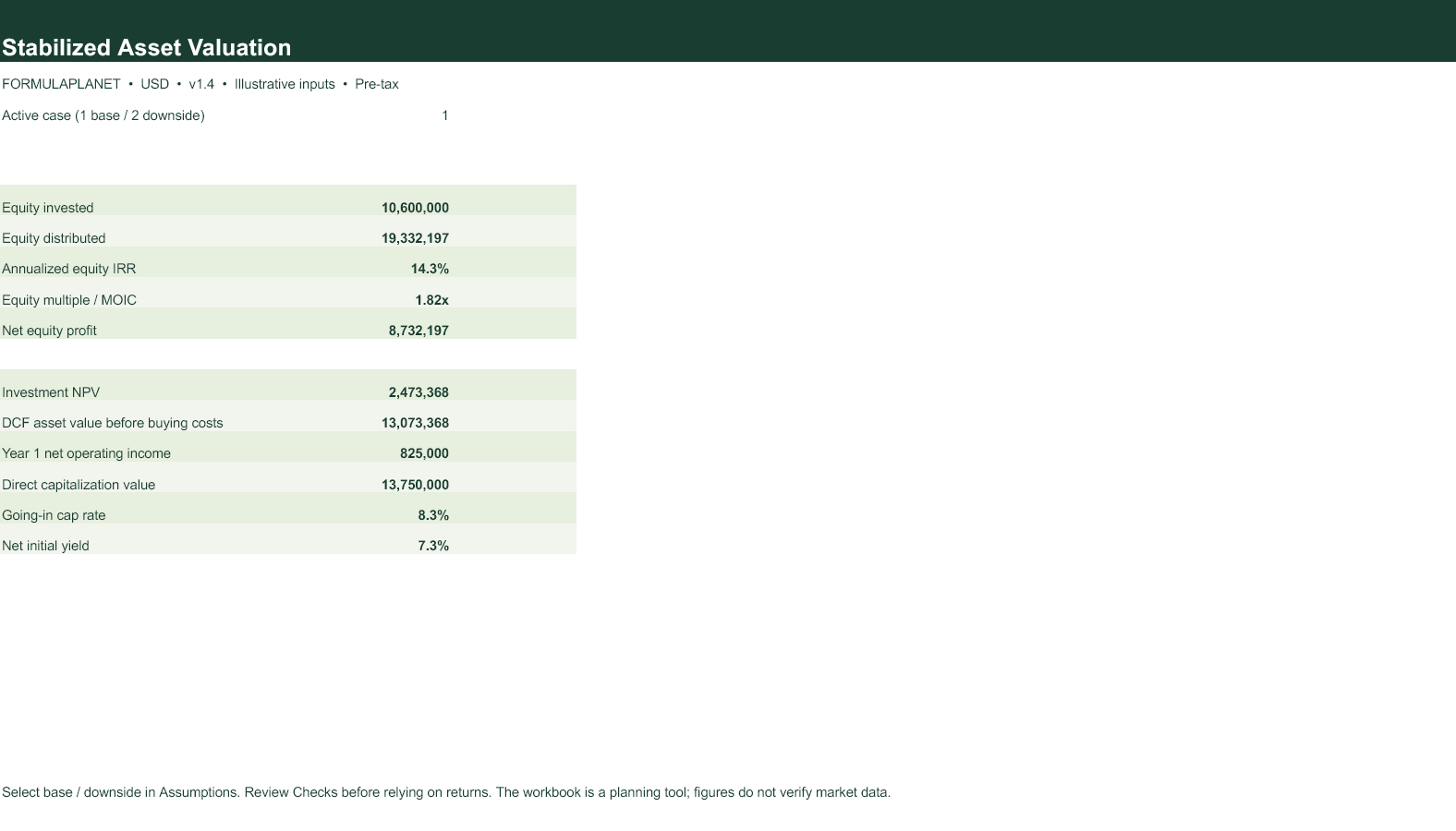
Read-only, saved illustrative workbook values. The displayed currency stays as saved and is independent of the calculator and payment currency.
A valuation model for stabilised income-producing property. It combines direct capitalisation with a multi-year DCF cross-check and separates current NOI, recurring capex, acquisition costs and terminal assumptions.
Your editable .xlsx file includes the complete workbook below. Open it in desktop Microsoft Excel and replace the worked example with your project.
The Checks sheet reconciles the forecast to net investment cash flow and checks the dashboard IRR calculation. Direct capitalisation uses NOI before recurring capex; net initial yield deducts capex separately.
Investors · Valuers · Asset managers · Family offices · Lenders.
Editable .xlsx · 6 worksheets · One organisation, unlimited projects.
Digital download · Your Excel file is emailed after payment.
A valuation model for stabilised income-producing property. It combines direct capitalisation with a multi-year DCF cross-check and separates current NOI, recurring capex, acquisition costs and terminal assumptions.
An editable .xlsx workbook with Dashboard, Assumptions, Forecast, Sensitivity, Checks, ReadMe worksheets.
Yes. The workbook licence covers internal and client analysis for one organisation, without a subscription. Reselling or redistributing the template is excluded.
Choose USD, EUR, GBP, INR (Indian rupee), CAD, AUD, NZD, CHF, JPY or AED in Assumptions!I6. USD is the default. All monetary inputs and outputs use one project currency. Changing the selector updates currency labels without converting amounts; replace the example inputs with local project data. Your workbook currency is independent of the currency you pay in.
No. Calculations use visible spreadsheet formulas and the file contains no VBA.
Enter sustainable rent, vacancy, operating costs, recurring capex, purchase costs and valuation rates. Input cells are visually distinguished from formulas; follow the ReadMe instructions.
Yes. Use the base/downside case selector and review the workbook’s Sensitivity sheet. The available assumptions depend on the model.
The Checks sheet reconciles the forecast to net investment cash flow and checks the dashboard IRR calculation. Direct capitalisation uses NOI before recurring capex; net initial yield deducts capex separately.
Defaults are illustrative, not current market evidence. Replace and independently verify them for every live transaction.
Use a current desktop release of Microsoft Excel. LibreOffice may format or calculate some financial functions differently.
Your order confirmation provides the purchased workbook, currently v1.4, updated 6 October 2026.
All 21 editable Excel workbooks. Development, acquisition, financing, equity and valuation in one collection.
Value property cash flow using explicit income, expenses, capex, discounting and terminal value.
Calculate acquisition loan capacity, amortisation, debt service, fees and equity funding.
Size a replacement loan and quantify proceeds, debt service, lender return and maturity balance.
Value contractual ground rent, stepped reviews and a terminal land reversion.
Estimate stabilised property value by capitalising sustainable NOI.
Calculate net operating income from gross income, vacancy and operating expenses.
Calculate the unleveraged income yield from annual NOI and property value.
Compare stabilised NOI with total development or acquisition cost.
Calculate the property-level return before financing from total cost, operating cash flow and sale proceeds.