Real Estate DCF Valuation Model
Value property cash flow using explicit income, expenses, capex, discounting and terminal value.
€49One payment · VAT included
Buy nowFinancial Model for Excel
Value contractual ground rent, stepped reviews and a terminal land reversion.

Secure checkout · Digital download
Follow rent reviews, landlord costs and the terminal land value through a finite annual lease forecast.
One currency for all project amounts. Changing it changes labels, not values.
Your base case. DCF land value: $9,178,314.
The first rent increase or decrease takes effect in year 6. Reversion is a separate cash receipt in year 10; it is not inferred from a rent yield.
This is the landlord’s perspective and a 1–10 year forecast. A longer lease requires extending the workbook’s annual schedule.
Landlord costs and recurring capex reduce income; collection loss applies to gross rent. There is no debt schedule or income-tax calculation.
A landlord ground-lease forecast for 1–10 years with periodic compounded rent reviews and explicit terminal land/improvement reversion. Contract-specific caps, floors, indexed rent clauses, financing and tax require separate analysis.
In year t, contractual rent = initial rent × (1 + annual review growth)^[floor((t − 1) ÷ review interval) × review interval]. Rent therefore stays flat between reviews; a five-year review first resets rent in year 6.
Collection loss is the entered percentage of rent. Annual landlord costs increase by their own growth rate. Recurring capex remains fixed each year. Landlord NOI is collected rent less operating costs.
The terminal land reversion is entered explicitly. Net reversion = gross reversion × (1 − disposal cost rate), received at the end of the selected lease term. No cap rate is used to invent a reversion value.
DCF land value discounts annual NOI after capex and net reversion to year 0. NPV also deducts the initial land purchase and buying costs. IRR uses the annual investment cash flows and is omitted where it is not uniquely established.
The web sensitivity values explicit reversion and discount-rate scenarios. It does not reuse a property rent-capitalisation sensitivity as a substitute for the contractual reversion.
Illustrative example, not a market forecast. All project amounts use USD. A dash means the measure is not applicable or a unique return cannot be established.
Enter ground rent, rent review intervals, landlord costs, the lease term, discount rate and terminal reversion.
Review stepped rent, landlord cash flow and the separate terminal reversion in the annual Forecast. The included term is 1–10 years.
Compare the base and downside assumptions, review the sensitivity analysis and follow the effect through the workbook.
Explore all 6 worksheets.
Version 1.4 · Updated 6 October 2026.
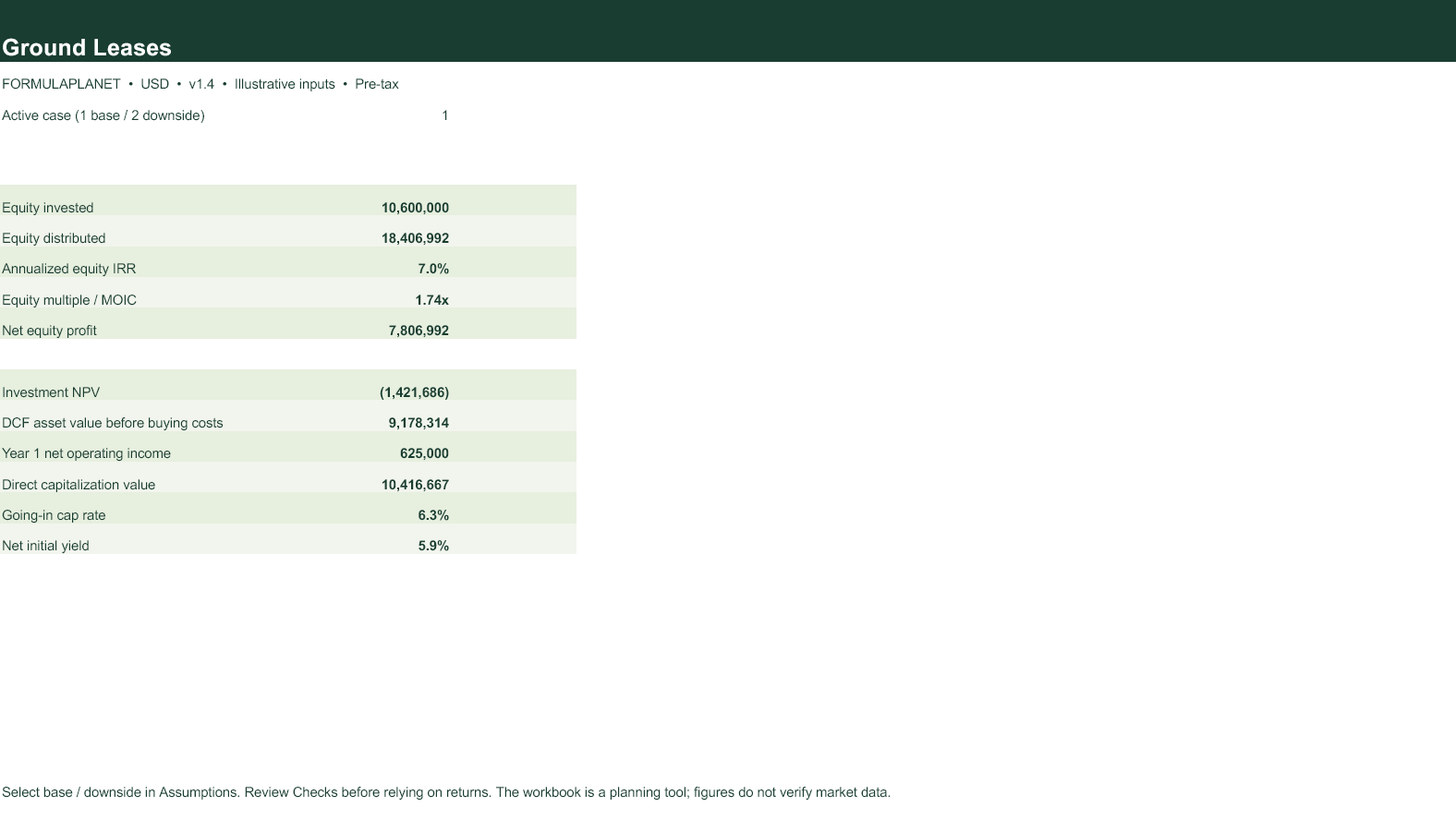
Read-only, saved illustrative workbook values. The displayed currency stays as saved and is independent of the calculator and payment currency.
A landlord-perspective DCF for ground leases. It models contracted rent, review intervals, landlord costs, the finite lease term and a separate terminal reversion rather than blending both into one capitalisation assumption.
Your editable .xlsx file includes the complete workbook below. Open it in desktop Microsoft Excel and replace the worked example with your project.
The Checks sheet reconciles rent, costs, reversion and acquisition expenditure to investment cash flow, and checks the dashboard IRR calculation. Terminal land reversion is entered separately from rent capitalisation.
Landowners · Investors · Valuers · Family offices · Lenders.
Editable .xlsx · 6 worksheets · One organisation, unlimited projects.
Digital download · Your Excel file is emailed after payment.

4 editable workbooks, selected for this sector. One purchase, no subscription.
See everything in this packA landlord-perspective DCF for ground leases. It models contracted rent, review intervals, landlord costs, the finite lease term and a separate terminal reversion rather than blending both into one capitalisation assumption.
An editable .xlsx workbook with Dashboard, Assumptions, Forecast, Sensitivity, Checks, ReadMe worksheets.
Yes. The workbook licence covers internal and client analysis for one organisation, without a subscription. Reselling or redistributing the template is excluded.
Choose USD, EUR, GBP, INR (Indian rupee), CAD, AUD, NZD, CHF, JPY or AED in Assumptions!I6. USD is the default. All monetary inputs and outputs use one project currency. Changing the selector updates currency labels without converting amounts; replace the example inputs with local project data. Your workbook currency is independent of the currency you pay in.
No. Calculations use visible spreadsheet formulas and the file contains no VBA.
Enter ground rent, rent review intervals, landlord costs, the lease term, discount rate and terminal reversion. Input cells are visually distinguished from formulas; follow the ReadMe instructions.
Yes. Use the base/downside case selector and review the workbook’s Sensitivity sheet. The available assumptions depend on the model.
The Checks sheet reconciles rent, costs, reversion and acquisition expenditure to investment cash flow, and checks the dashboard IRR calculation. Terminal land reversion is entered separately from rent capitalisation.
Defaults are illustrative, not current market evidence. Replace and independently verify them for every live transaction.
Use a current desktop release of Microsoft Excel. LibreOffice may format or calculate some financial functions differently.
Your order confirmation provides the purchased workbook, currently v1.4, updated 6 October 2026.

All 21 editable Excel workbooks. Development, acquisition, financing, equity and valuation in one collection.
Value property cash flow using explicit income, expenses, capex, discounting and terminal value.
Translate sustainable rent and operating costs into direct capitalisation and DCF values.
Evaluate land acquisition, infrastructure costs, phased plot sales, debt repayment and profit.
Calculate acquisition loan capacity, amortisation, debt service, fees and equity funding.
Calculate the property-level return before financing from total cost, operating cash flow and sale proceeds.
Estimate stabilised property value by capitalising sustainable NOI.
Calculate the unleveraged income yield from annual NOI and property value.
Measure investment profit as a percentage of invested cost.