
Hotel Acquisition Model
See how much cash you need to buy an existing hotel, what it could earn after loan payments, and how your return changes if business slows.
€69One payment · VAT included
Buy nowFinancial Model for Excel
Connect room strategy, construction costs, operating performance, financing and exit returns.

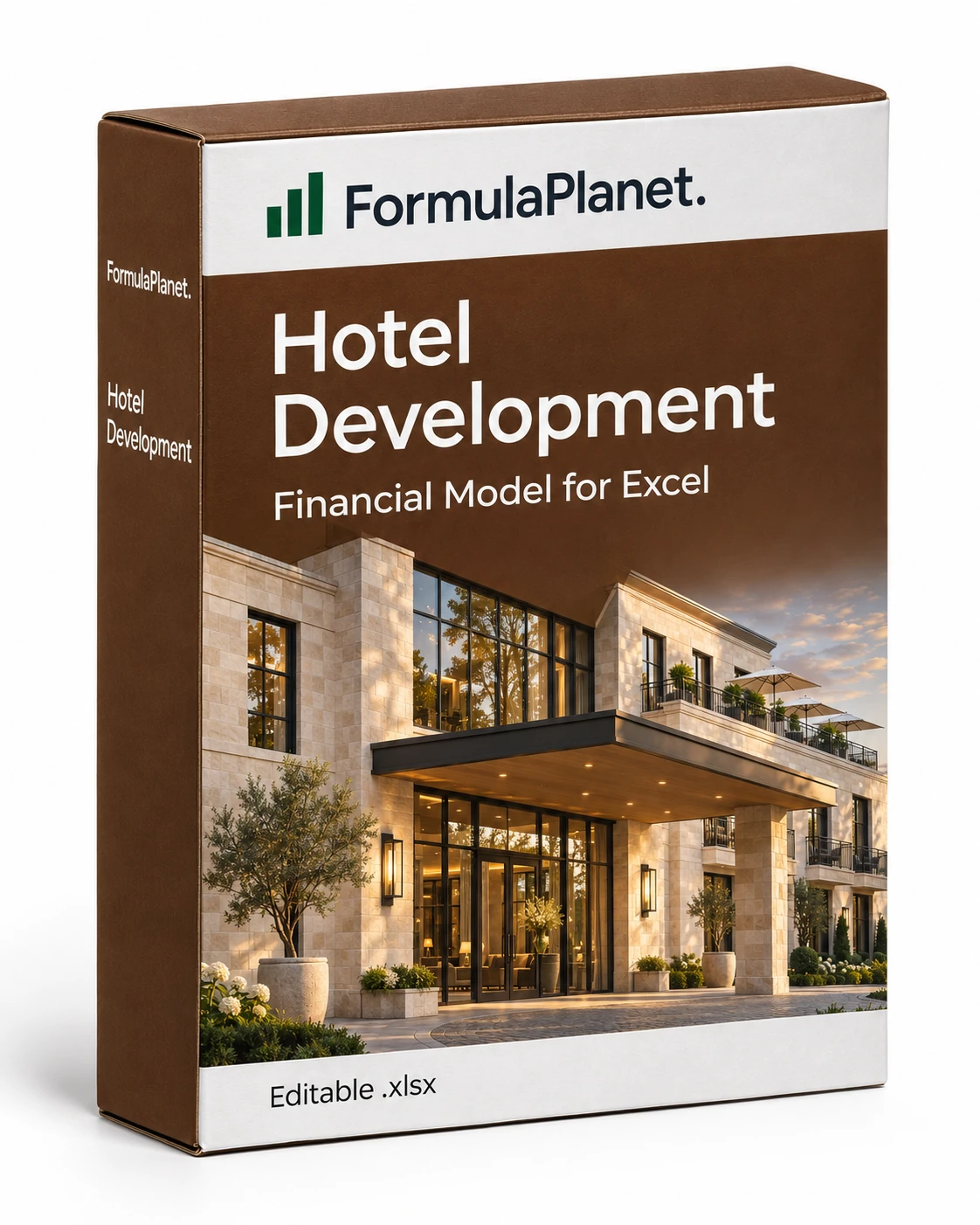
Secure checkout · Digital download
Connect rooms, ADR, occupancy and ancillary revenue to hotel NOI, FF&E reserves, construction funding and an income-based exit.
One currency for all project amounts. Changing it changes labels, not values.
Entered case. Annualised equity IRR: 62.4%.
Stabilised operations begin in month 36; exit occurs in month 60. The operating cash metric separates income after reserves and interest from the final sale proceeds.
Illustrative inputs. All monetary amounts use the selected project currency without exchange-rate conversion. Results are nominal and before income tax and VAT.
Negative equity cash flow is a contribution; positive cash flow is a distribution. Equity funds interest and any debt repayment shortfall at exit.
A compact monthly property forecast with one construction / renovation phase, aggregate income, interest-only debt and a 12–120 month exit. It excludes refinancing, lease-by-lease detail, income tax and VAT. The full editable XLSX includes a separate lease-up assumption and refinancing controls alongside its detailed schedules.
Acquisition and acquisition costs are paid at month 0. Hard costs, professional fees, contingency and any separate enabling works are spent evenly during construction / renovation. Interest is excluded from capital cost.
Room revenue = rooms × ADR × 365 × occupancy. Ancillary income is added separately. The monthly revenue index is 0.85 for months 1–3, 1.075 for months 4–9 and 1.00 for months 10–12, repeating annually; its annual average is 1.00.
No income is earned during construction. Occupancy ramps linearly after completion. Income growth compounds from the initial underwriting date, including the construction period.
Debt funds the entered percentage of each eligible capital payment. Monthly interest uses opening debt plus half the current draw. Interest is paid from equity; no interest capitalisation, amortisation or refinancing is included.
The exit capitalises forward annual stabilised NOI before recurring capex. Selling costs and outstanding debt are deducted; equity pays any shortfall. NOI, capex reserve and interest remain separate cash-flow items.
Equity IRR uses end-of-month cash flows and is annualised as (1 + monthly IRR)^12 − 1. MOIC uses all positive cash flows divided by all negative contributions. NPV discounts each month using the annual equity discount rate. IRR is left unavailable when a unique result cannot be established.
Illustrative example, not a market forecast. All project amounts use USD. A dash means the measure is not applicable or a unique return cannot be established.
Enter hotels project costs, completion timing, rental or room income, occupancy, operating costs and financing.
Review the Monthly, Annual and Lender sheets for construction, lease-up, cash flow, refinancing and exit proceeds.
Compare the base and downside assumptions, review the sensitivity analysis and follow the effect through the workbook.
Explore all 8 worksheets.
Version 1.4 · Updated 6 October 2026.
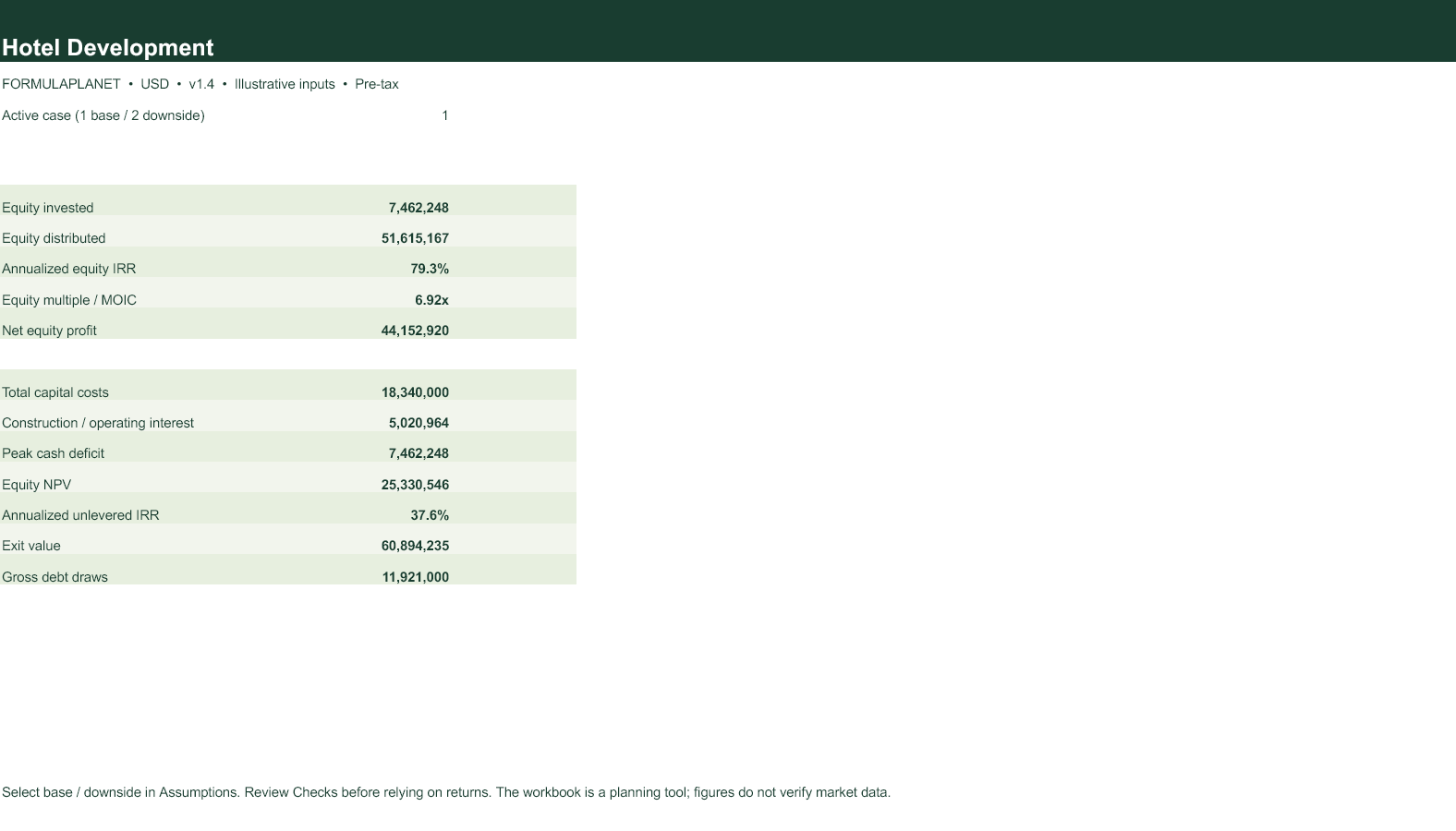
Read-only, saved illustrative workbook values. The displayed currency stays as saved and is independent of the calculator and payment currency.
A hotel feasibility and development model built around rooms, ADR, occupancy, seasonality and ancillary revenue. It translates operational assumptions into development cost, NOI, debt capacity, cost per key and investor returns.
Your editable .xlsx file includes the complete workbook below. Open it in desktop Microsoft Excel and replace the worked example with your project.
The Checks sheet reconciles capital costs, the debt roll-forward and final debt balance, and checks the dashboard IRR calculation. The forecast supports construction and lease-up within a maximum of 120 months.
Hotel developers · Hotel owners · Investors · Operators · Lenders · Analysts.
Editable .xlsx · 8 worksheets · One organisation, unlimited projects.
Digital download · Your Excel file is emailed after payment.
4 editable workbooks, selected for this sector. One purchase, no subscription.
See everything in this packA hotel feasibility and development model built around rooms, ADR, occupancy, seasonality and ancillary revenue. It translates operational assumptions into development cost, NOI, debt capacity, cost per key and investor returns.
An editable .xlsx workbook with Dashboard, Assumptions, Monthly, Annual, Lender, Sensitivity, Checks, ReadMe worksheets.
Yes. The workbook licence covers internal and client analysis for one organisation, without a subscription. Reselling or redistributing the template is excluded.
Choose USD, EUR, GBP, INR (Indian rupee), CAD, AUD, NZD, CHF, JPY or AED in Assumptions!I6. USD is the default. All monetary inputs and outputs use one project currency. Changing the selector updates currency labels without converting amounts; replace the example inputs with local project data. Your workbook currency is independent of the currency you pay in.
No. Calculations use visible spreadsheet formulas and the file contains no VBA.
Enter hotels project costs, completion timing, rental or room income, occupancy, operating costs and financing. Input cells are visually distinguished from formulas; follow the ReadMe instructions.
Yes. Use the base/downside case selector and review the workbook’s Sensitivity sheet. The available assumptions depend on the model.
The Checks sheet reconciles capital costs, the debt roll-forward and final debt balance, and checks the dashboard IRR calculation. The forecast supports construction and lease-up within a maximum of 120 months.
Defaults are illustrative, not current market evidence. Replace and independently verify them for every live transaction.
Use a current desktop release of Microsoft Excel. LibreOffice may format or calculate some financial functions differently.
Your order confirmation provides the purchased workbook, currently v1.4, updated 6 October 2026.

All 21 editable Excel workbooks. Development, acquisition, financing, equity and valuation in one collection.
See how much cash you need to buy an existing hotel, what it could earn after loan payments, and how your return changes if business slows.
Size a construction facility and create a monthly debt draw, interest and maturity schedule.
Value property cash flow using explicit income, expenses, capex, discounting and terminal value.
Allocate whole-deal cash flow between LP and GP through preferred return and promote tiers.
Estimate hotel development cost from room count, cost per key and site cost.
Calculate total hotel investment per completed guest room.
Estimate occupancy required for room contribution to cover fixed annual costs.
Turn rooms, ADR, occupancy and operating margin into an indicative hotel value.
Estimate facility size and interest using an LTC limit and evenly phased monthly draws.